Loading...
Serving Lancaster, CA and surrounding areas(661) 952-4736
Lancaster Insulation Company serves California City, CA with commercial insulation, spray foam, attic upgrades, and vapor barrier work for the Mojave Desert. California City covers over 203 square miles with a tight residential core and a mix of commercial and industrial properties. Summer highs reach the high 90s; winter nights drop near freezing. Our crew is familiar with the area and handles both residential and commercial projects. We have completed more than 450 insulation jobs across Kern County and the Antelope Valley since 2022.
California City was founded in 1958 as a planned desert city designed for 400,000 residents, incorporated in 1965 with fewer than 1,000 people, and today covers 203 square miles — the third-largest city by land area in California. The actual residential population of about 15,000 is clustered in the western portion of the city, leaving vast grids of platted-but-empty desert streets extending east and north. That low-density layout means homes here are spread far apart, and a service crew needs to know the area to schedule efficiently.
The residential core centers on California City Central Park and its 26-acre manmade lake, one of the few surviving features of the original 1958 master plan. Many residents are employed at Edwards Air Force Base 18 miles southeast, at the California City Correctional Center, or at the Mojave Air and Space Port just northwest of town. The city also has a dedicated off-highway vehicle recreation area that is one of the more popular OHV destinations in the western Mojave.
Nearby Rosamond is within our service area as well. We serve both communities on the same scheduling corridor and are familiar with the roads and property types in each.
California City's commercial and industrial properties — including buildings along California City Boulevard and near the municipal airport — require insulation systems sized for extreme desert thermal loads. Every commercial project here includes a Title 24 compliance report and permit coordination so the job closes cleanly.
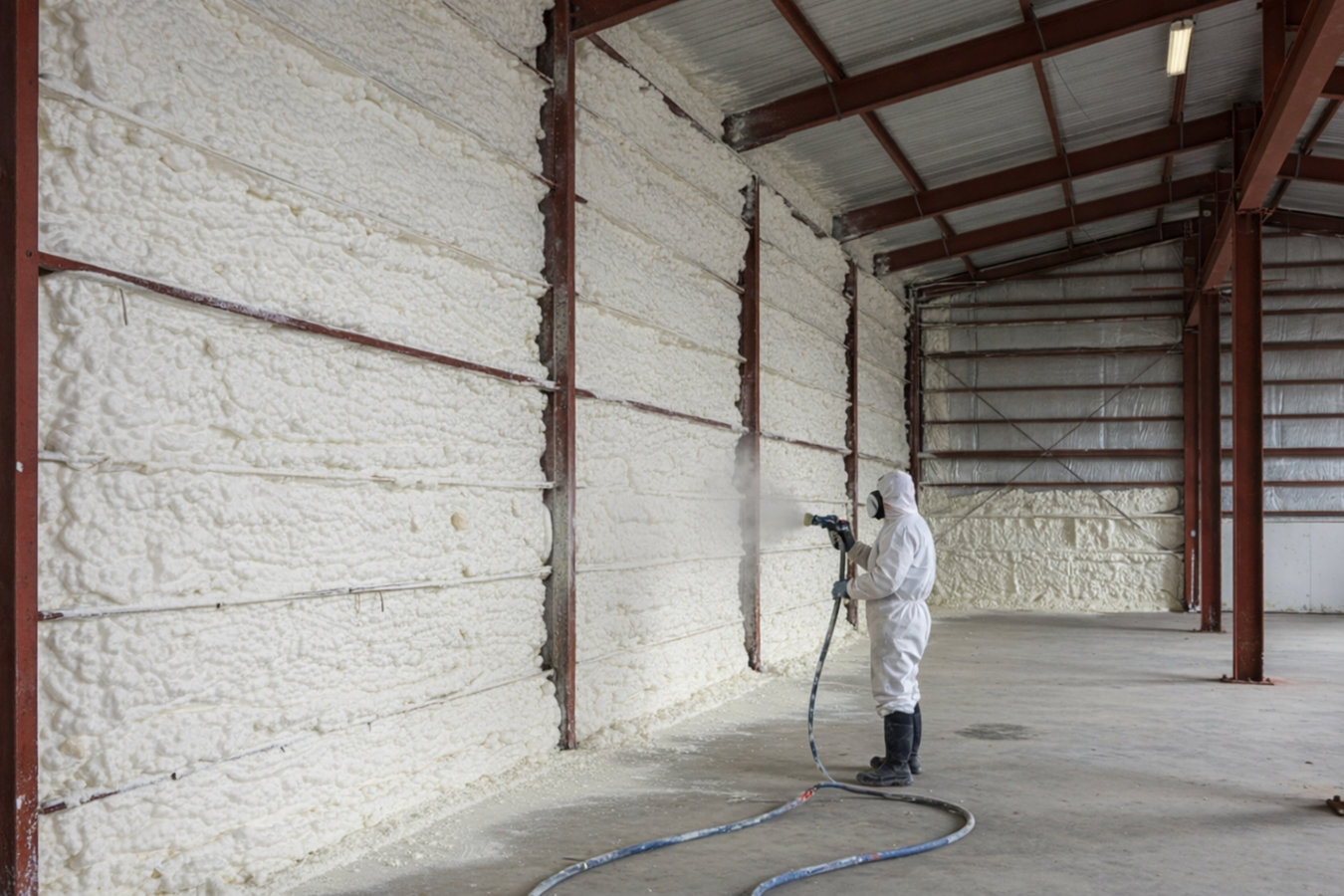
Closed-cell spray foam is the most effective choice for metal buildings and warehouses in the Mojave. It eliminates thermal bridging through structural steel, creates a continuous air and vapor barrier, and handles the temperature swings California City sees without degrading over time.
Residential homes in California City bake under July highs near 97 degrees. Most of the city's single-family stock was built during the 1970s and 1980s with attic insulation well below current California Energy Code minimums. An upgrade to R-38 or above makes a measurable difference in cooling costs from June through September.
The Mojave Desert is dry, but homes with crawl spaces in California City still benefit from a properly installed vapor barrier. Desert soil can release moisture during seasonal temperature shifts, and an unprotected crawl space allows that moisture to migrate into floor systems and lower living spaces over time.
Rosamond sits about 20 miles south of California City along Rosamond Boulevard. We serve homeowners in both communities on the same run and schedule work across the corridor without requiring separate mobilization fees. Residential insulation needs in Rosamond closely mirror what we find in California City's desert-floor housing stock.
Loose-fill insulation is an efficient way to bring older California City attics up to code-level performance. It installs in one visit over existing material, adapts to any joist pattern, and is well-suited to the wide, single-story ranch homes that dominate the residential areas around Central Park.
California City sits in the northern Antelope Valley at about 2,400 feet, fully inside the Mojave Desert. Average highs in July reach 97 degrees. December nights average lows near 33 degrees. The gap between summer peak and winter trough is roughly 64 degrees across the calendar year — more than many homeowners realize before their first full cycle of utility bills in the city.
Most of the residential housing stock was built during the 1970s and 1980s as the city tried to grow toward its original master-plan vision. Those homes were constructed to the energy standards of that era, which were minimal by current California Title 24 measures. Attic insulation in the R-11 to R-19 range was common. Air barriers were rarely detailed. Wall cavities in many older ranch-style homes near downtown and the Central Park neighborhood were left partially or entirely uninsulated.
The commercial side has its own set of challenges. The Garlock Fault runs in the vicinity of the city, and the Antelope Valley's strong prevailing winds create persistent pressure against building envelopes. Commercial buildings that lack a continuous air barrier see their insulation R-value effectively reduced because outdoor air bypasses the thermal layer through gaps at penetrations and transitions. In a desert city with SCE electricity costs and summer cooling demands, that lost performance translates directly to higher operating costs every month.
We are familiar with California City's layout — the residential areas cluster west of California City Boulevard near the Central Park lake, while properties thin out rapidly as you move east or north into the original platted grid that was never built out. We know the difference between a job off Neuralia Road near the golf course and one that requires a longer drive along the outer perimeter streets. Scheduling here means accounting for actual travel distances in a way that only matters in a city this size.
Commercial projects near the California City municipal airport require permits through the city's Building and Safety department, and every commercial insulation job here needs a Title 24 compliance report on file. We coordinate that documentation as part of the project so the permit closes without delays. For residential work, we are also familiar with the homeowner profiles in this community — many residents work shifts at Edwards AFB or the correctional center, so we accommodate early-morning start times and flexible scheduling windows when that helps.
We serve Lancaster and Rosamond on the same scheduling corridor and can often combine California City visits with work at nearby properties to keep travel efficient for all customers.
Call or submit the online estimate form any time. We respond within 1 business day to confirm your property address and arrange a free on-site visit. California City's lot sizes and address numbering can be unusual — providing cross-street information helps us find you quickly.
A crew member measures your attic depth, inspects crawl spaces, and walks the perimeter of any commercial area in scope. You receive a written quote with a flat price. For commercial projects, we also identify whether a Title 24 compliance report is required before the permit application so costs are transparent up front — no surprises after the permit counter review.
Most residential projects complete in a single day. Commercial projects involving spray foam on a large metal roof or warehouse ceiling are typically scoped over two visits depending on square footage. We clean up on completion and do not leave material staging at the property overnight.
You receive all project records at completion: permit documentation if applicable, material specifications, and for commercial projects the Title 24 compliance certificate. Residential customers receive the material spec sheet needed for the IRA 25C tax credit filing with their accountant.
We respond to California City inquiries within 1 business day. The on-site estimate is free and carries no obligation. After you submit, someone familiar with the city's layout and property types will reach out to schedule your visit.
(661) 952-4736Spray polyurethane foam that expands into gaps to create an airtight thermal barrier in walls, roofs, and crawl spaces.
Learn moreAttic insulation upgrades that reduce heat transfer through the roof deck and keep indoor temperatures stable year-round.
Learn moreLoose-fill cellulose or fiberglass blown into attics and enclosed cavities for fast, even coverage without major demolition.
Learn moreWhole-home insulation assessments and installs addressing every area where conditioned air is lost.
Learn moreSafe extraction of old, damaged, or contaminated insulation before a new installation or remediation project.
Learn moreInsulation and encapsulation under the floor to prevent moisture intrusion and thermal loss from below.
Learn moreRetrofit and new-construction wall insulation that improves thermal performance and reduces outside noise.
Learn moreIdentification and sealing of air leaks around penetrations, rim joists, and top plates to tighten the building envelope.
Learn moreBasement wall and rim joist insulation that controls moisture and reduces heat loss in below-grade spaces.
Learn moreHigh-density closed-cell spray foam with a high R-value per inch, vapor resistance, and structural rigidity.
Learn moreSofter, lower-density open-cell foam ideal for interior walls, sound dampening, and attic applications.
Learn moreTargeted air sealing of the attic floor plane to stop conditioned air from escaping into unconditioned attic space.
Learn moreHeavy-duty poly sheeting installed on crawl space floors and walls to block ground moisture from entering the home.
Learn moreVapor retarder installation in walls, crawl spaces, and basements to manage moisture and prevent mold growth.
Learn moreInsulation added to existing homes without full demolition, using dense-pack or injection techniques.
Learn moreCommercial-grade insulation for warehouses, office buildings, and retail spaces to meet energy codes and reduce operating costs.
Learn moreServing these cities and communities.
Call or request a free estimate online — we serve California City and the surrounding Kern County Mojave Desert communities.