Loading...
Serving Lancaster, CA and surrounding areas(661) 952-4736
Lancaster Insulation Company serves Rosamond, CA with blown-in attic insulation, spray foam, and air sealing work designed for the northern Antelope Valley's climate. Rosamond is an unincorporated Kern County community at 2,000 to 3,000 feet elevation, sitting at the edge of the Mojave Desert near Edwards Air Force Base. The homes here were mostly built after 2000 in Craftsman and ranch styles, and while they tend to be better insulated than Lancaster's 1980s inventory, many still fall short of today's California standards. We respond within one business day and are licensed under California's C-2 Insulation and Acoustical Contractor classification.
Rosamond is a census-designated place in Kern County, just north of the Los Angeles County line, with a population of 20,961 as of the 2020 census. Because it is unincorporated, Kern County administers local services rather than a city government. The community sits at the northern end of the Antelope Valley and is widely known as a bedroom community for Edwards Air Force Base, roughly 20 miles to the east, which employs thousands of military personnel, civilian staff, and aerospace defense contractors — including Lockheed Martin and Northrop Grumman workers supporting flight-test operations. NASA's Armstrong Flight Research Center is also located at Edwards, giving the corridor a notable concentration of technical professionals.
The community's roots go back to 1877 when the Southern Pacific Railroad established it as a townsite, later named after a railroad official's daughter. Gold discoveries in the 1890s brought a prospector boom, and ranching and mining shaped the area for decades before the aerospace economy took hold. Today the residential stock is predominantly post-2000 Craftsman and ranch-style single-family homes, with a median price around $430,000 and a homeownership rate of roughly 67.7%.
Rosamond neighbors Lancaster to the south and California City to the northeast, and we serve homeowners across all three communities along the SR-14 and US-395 corridor.
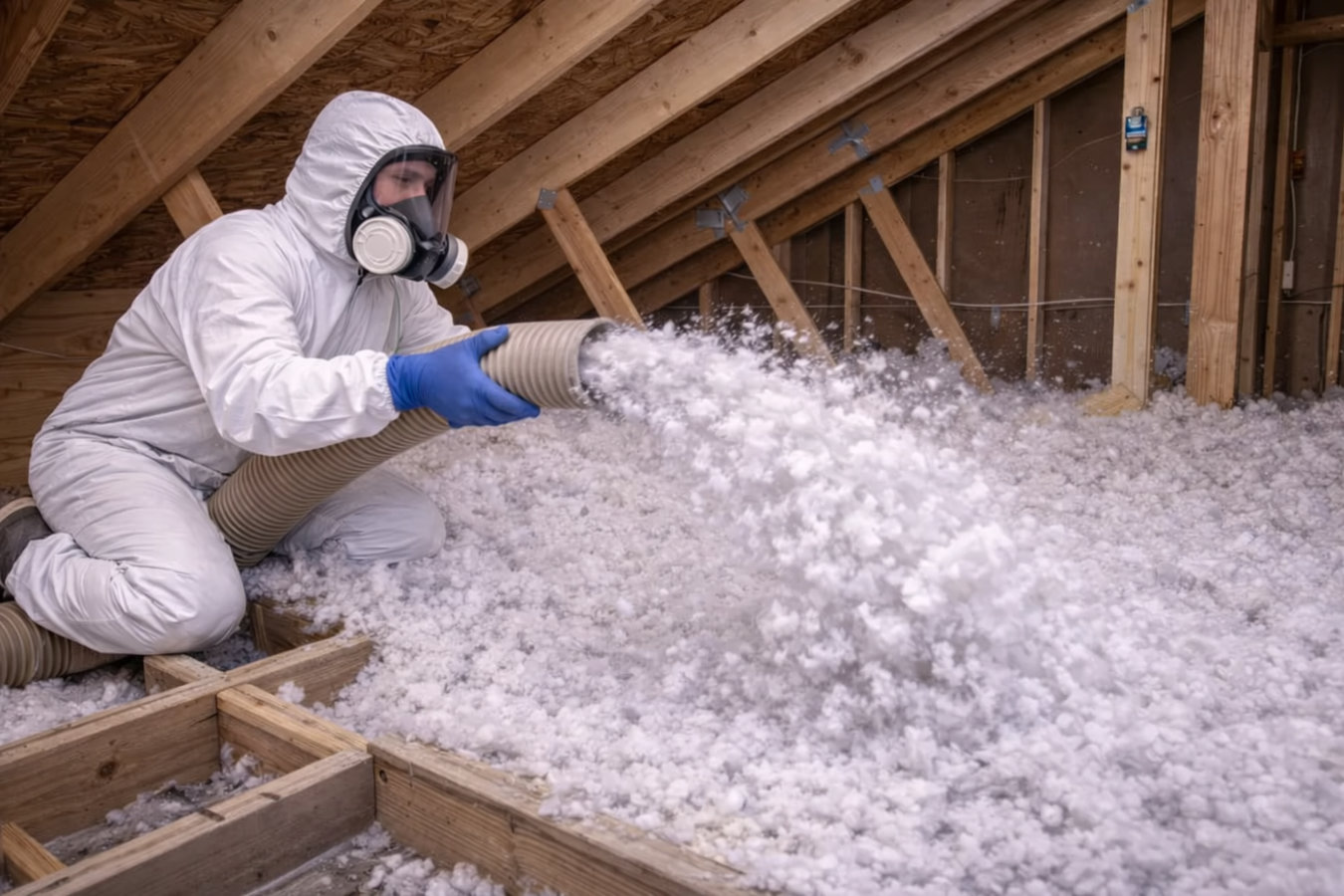
Rosamond's post-2000 homes typically have finished attic floors and narrow access hatches that make batt installation impractical after construction. Loose-fill blown into the existing cavity is the most effective retrofit method — it reaches target depths in a single pass and conforms to the varied framing the area's Craftsman-influenced designs produce.
Summer days in Rosamond regularly push 100°F, driving attic temperatures to 150°F or higher. Homes with attic insulation below R-38 transfer significant heat into living spaces through the ceiling assembly. A depth inspection tells you the current R-value and how much material is needed to close the gap.
Rosamond's location in the open Mojave Desert means persistent wind events push outside air through top plate gaps and around recessed lighting fixtures. Sealing those penetrations before adding blown-in material is the difference between an insulation upgrade that holds its performance and one that underperforms by year two.
Closed-cell spray foam is the right choice for Rosamond homes with garage-conversion projects or bonus rooms being brought into the conditioned envelope. It seals and insulates in one application and performs well in the high thermal cycling between the area's cold winters and hot summers.
When attic insulation has been disturbed by pest activity or soaked during a roof leak, adding new material over compromised coverage does not restore full performance. Removal and replacement gives you a clean start and accurate depth from day one.
Lancaster is our home base, 20 miles south of Rosamond on SR-14. Rosamond customers benefit from the same high-desert expertise we have developed over years of work on Antelope Valley homes, and scheduling a Rosamond job alongside a Lancaster stop is straightforward for our crews.
Rosamond's climate is demanding in a way that coastal California homeowners rarely experience. At 2,000 to 3,000 feet in the Mojave Desert, summer highs regularly exceed 100°F — with recorded extremes above 110°F — while winter nights can drop below freezing, sometimes with frost and occasional light snow. That 70-to-80 degree daily swing during shoulder seasons puts continuous mechanical stress on attic insulation and accelerates the compression and settling that reduces R-values over time.
Unlike Lancaster's predominantly 1980s tract housing, Rosamond's stock skews newer — most homes here were built in the 2000s and early 2010s, following Kern County's growth as a bedroom community for Edwards AFB. That means the insulation baseline is generally better than Lancaster, but the homes were still built to Title 24 standards from a decade or more ago. Many have attic insulation in the R-25 to R-30 range, short of the R-38 that current California standards recommend for Climate Zone 14 and 15.
Rosamond's proximity to Willow Springs International Motorsports Park and the open Mojave Desert to the north and west means the community experiences some of the strongest unobstructed wind events in the Antelope Valley. Wind-driven air infiltration through attic penetrations is a significant source of energy loss that insulation depth alone cannot address — which is why air sealing is a standard part of every attic upgrade we complete in this area.
Rosamond sits across the county line from Lancaster — Kern County rather than Los Angeles County — and that matters operationally when a job involves permitted work. When a Rosamond project requires a permit, it goes through the Kern County Building Inspection Division on Truxtun Avenue in Bakersfield, not through an LA County office. That is a detail we confirm before quoting permitted scopes rather than after, because timeline expectations and fee structures are different from what LA County homeowners are used to.
Rosamond's ranch-style and Craftsman homes on Sierra Highway and Rosamond Boulevard tend to have wider attic spans than the narrower 1,400 square foot tract homes in parts of Lancaster. That means blower setup and material staging outside is different here — we bring a larger hose run and typically plan for a longer day than a comparably sized Lancaster job. The town's Southern Kern Unified School District schools, including Rosamond High School and Tropico Middle School, are reference landmarks our crew uses for routing and access.
We also serve customers in neighboring Tehachapi to the northwest and California City to the east, both of which have distinct climate conditions that shape insulation requirements differently from Rosamond but that sit within our regular service geography.
Call or submit a form and you will receive a reply within one business day. Because Rosamond is roughly 20 miles north of our Lancaster base, we combine Rosamond visits with other Antelope Valley north-end appointments to keep scheduling efficient.
A technician inspects the attic, measures existing depth, and checks air sealing conditions. The written estimate specifies material type, target depth, and final cost — no open-ended line items and no pricing surprises on installation day.
Most Rosamond attic jobs finish in a single visit. You do not need to take time off work — attic access is the only requirement. The crew handles staging, installation, and cleanup before leaving.
You receive a completion record with final depth measurements and achieved R-value. Rosamond residents served by SCE can use this documentation when applying for the Energy Savings Assistance Program rebate.
We reply within one business day and the on-site assessment is free with no obligation. Most Rosamond jobs are scheduled within a week of quote approval. The written estimate locks in your price before installation begins.
(661) 952-4736Spray polyurethane foam that expands into gaps to create an airtight thermal barrier in walls, roofs, and crawl spaces.
Learn moreAttic insulation upgrades that reduce heat transfer through the roof deck and keep indoor temperatures stable year-round.
Learn moreLoose-fill cellulose or fiberglass blown into attics and enclosed cavities for fast, even coverage without major demolition.
Learn moreWhole-home insulation assessments and installs addressing every area where conditioned air is lost.
Learn moreSafe extraction of old, damaged, or contaminated insulation before a new installation or remediation project.
Learn moreInsulation and encapsulation under the floor to prevent moisture intrusion and thermal loss from below.
Learn moreRetrofit and new-construction wall insulation that improves thermal performance and reduces outside noise.
Learn moreIdentification and sealing of air leaks around penetrations, rim joists, and top plates to tighten the building envelope.
Learn moreBasement wall and rim joist insulation that controls moisture and reduces heat loss in below-grade spaces.
Learn moreHigh-density closed-cell spray foam with a high R-value per inch, vapor resistance, and structural rigidity.
Learn moreSofter, lower-density open-cell foam ideal for interior walls, sound dampening, and attic applications.
Learn moreTargeted air sealing of the attic floor plane to stop conditioned air from escaping into unconditioned attic space.
Learn moreHeavy-duty poly sheeting installed on crawl space floors and walls to block ground moisture from entering the home.
Learn moreVapor retarder installation in walls, crawl spaces, and basements to manage moisture and prevent mold growth.
Learn moreInsulation added to existing homes without full demolition, using dense-pack or injection techniques.
Learn moreCommercial-grade insulation for warehouses, office buildings, and retail spaces to meet energy codes and reduce operating costs.
Learn moreServing these cities and communities.
Book a free attic assessment and get a written quote before the next summer billing cycle hits.